
Sustainability is defined as "managing
the earth and human use of its resources so as to keep human civilization
going indefinitely."
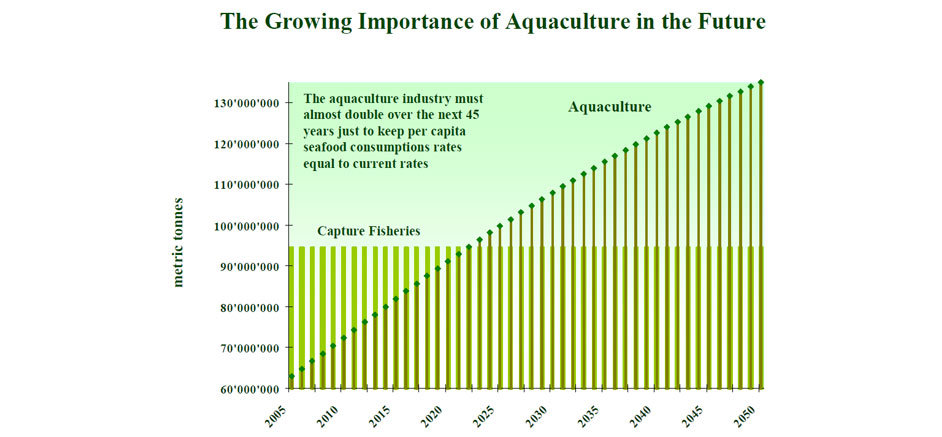
Taking a long-term view, aquaculture really continues to offer the only viable alternative to continued depletion of our natural fisheries. According to FAO statistics, aquaculture's contribution to global supplies of fish, crustaceans and molluscs continues to grow, increasing from 3.9 percent of total production by weight in 1970 to 27.3 percent in 2000. The United Nations has estimated that for the entire aquaculture industry to simply keep pace with world population growth in the future, total aquaculture output will have to double in less than fifteen years. Aquaculture is growing more rapidly than all other animal food producing sectors. Worldwide, the sector has increased at an average compounded rate of 9.2 percent per year since 1970, compared with only 1.4 percent for capture fisheries and 2.8 percent for terrestrial farmed meat production systems. During the past three decades, aquaculture has expanded, diversified, intensified and made technological advances. The potential of this development to enhance local food security, alleviate poverty and improve rural livelihoods has been well recognized. Global leadership now recognizes the need for the aquaculture sector to continue development towards its full potential, making a net contribution to global food availability, domestic food security, economic growth, trade and improved living standards. While these are lofty and laudable goals, aquaculture faces its own serious issues of sustainability that must be dealt with in a responsible manner. Aquaculture must continue to proceed in a more environmentally conscious manner. Lessons must be learned from the failures of many aquaculture operations worldwide and sustainable solutions must be enacted. The intensification in the aquaculture effort worldwide over the last several decades has clearly exposed the risks associated with culturing aquatic animals. Without proper management, aquaculture can put a great deal of strain on the surrounding natural ecosystems. The high densities of organisms, high artificial feed inputs and the subsequent generation of heavy organic loads in the water stream are the primary sources of most of the environmental problems associated with aquaculture. In developing countries, which is where most aquaculture production takes place, fish and shrimp farming operations have been developed at rapid growth rates with little regard for the environment or neighboring farmers. As is often the case, the abundance of natural resources are taken for granted in these locales. Destruction of mangroves, while much less frequent these days, has been associated with development of shrimp farms in the past. Aquaculture is seen as an opportunity for a better life and these resources are seen as a means to an end for many small local land owners facing poverty. The shrimp farming industries of China, Taiwan, Thailand, Ecuador and India offer prime examples of what can occur when over-intensification overrides concern for the environment. All of these countries have experienced the serious consequences of unmanaged growth of shrimp farming regions. In some cases, entire industries have failed and millions of dollars in investment have been lost. The vast majority of the production crashes occurring in these countries have been traced to either unsustainable development or improper farm management. China and Taiwan have yet to recover from their devastating industry collapses. Fortunately, regulation of the aquaculture industry is already occurring in places like Thailand and India. Environmental issues will continue to play an increasingly important role in the development of aquaculture projects worldwide. At AquaSol, we know that sustainable solutions to these difficult issues do exist. These solutions, if properly implemented, will permit the industry to continue to flourish in a way that will be in harmony with nature. SolutionsWhat is needed by farmers worldwide is a greater understanding of the ecological impacts of unmanaged growth. Fortunately, awareness of the intricate ties to the environment are becoming considerably clearer to many farmers and step are being taken to preserve this vital link. For many, it is simply a matter of self-preservation. By taking no action, they realize that the future of their farm is in jeopardy. A number of methods are available to minimize the environmental impact
and even improve the culture environment at the same time. For starters,
all farmers should stay within the bounds of sustainable production levels,
given their technical expertise, resources and location. Moderate stocking
densities, use of high quality feeds, aeration, pond-based recycling systems,
closed recirculating systems, settling ponds, constructed wetlands, integration
with more traditional forms of agriculture, minimal use of organic and
inorganic fertilizers, biological filtration, organized farming community
discharge programs, government mandated monitoring programs and industry-wide
self regulations are all important options for sustainable farming in
the new millennium. Settling ponds have proven to be an effective means of reducing source pollution. Recent experimental work in this field is very encouraging. There is even some evidence to support the premise that settling ponds can actually increase productivity in a pond-based water recycling system. Settling ponds act as a buffer, filtering the water through natural biological means. Filter feeding mollusks such as clams and oysters, algae's such as Gracilaria and fish like Tilapia can all thrive in nutrient rich waters offered by aquaculture operations. New technologies using the natural filtering capacity of floating aquatic plants such as duckweed and water hyacinths are showing great promise for filtering out harmful levels of ammonia and phosphorous. The downside to the settling pond strategy and water filtration strategies are that they can be costly to build. These strategies also require using and investing in land that could otherwise be developed for shrimp of fish production. One of the problems with creating sustainable approaches to aquaculture development is quite simply, economics. Aquaculture production is still dominated by many small local growers and for this type of farmer the unfortunate reality is that it is easier and cheaper to build farms with little regard for the local environment. Larger farms have found it very difficult to pass on environmental control costs to consumers in a highly competitive free market system such as the seafood industry. As it is with most sustainable solutions for aquaculture, there is a required investment required that negatively impacts the company's bottom line over the short term. Unfortunately, this unstable marriage between corporations seeking profits and the environment has historically resulted in the environment being the loser. This short sighted behavior is detrimental to the company in the long run because the entire pond production ecosystem is eventually effected, putting the future of the company itself in jeopardy. Our PhilosophyWe believe there is a responsibility of all aquaculturists to adhere to their own stringent internal operational guidelines that are designed to achieve long-term sustainability of their operation while at the same time protects their surrounding environment. In this regard, AquaSol, Inc. practices what we preach. For all projects under our control, we make every possible effort to preserve and conserve the surrounding environment. We firmly believe that our projects serve as models for other aquaculture projects worldwide. Farms designed by AquaSol, Inc. provide a more balanced and sustainable solutions for future aquaculture production. We encourage you to find out how we can help your existing or proposed farm reach the ultimate goal of sustainability and profitability. |